There is one number for how fast the universe is expanding today: the Hubble constant, H₀, quoted in kilometers per second per megaparsec. Cosmologists have two fundamentally different ways of arriving at it, built by different people out of different physics, and for decades the expectation was that as each sharpened the two answers would close. Instead they pulled apart.
Measurement error shrinks when you look harder — more or less what makes it error. A gap that widens as both sides grow more careful is behaving like something else — not the kind of error that more care removes.
Nobody has laid a ruler against the universe. Each method is a chain — a physical assumption, an instrument built to exploit it, and a sequence of steps converting what it records into a rate of expansion — and the number emerging at the far end is the universe as seen through one particular set of assumptions. Read that way the two routes are not rival readings of one quantity but two arguments that happen to end in the same units, and a disagreement between them is a fact about the arguments as much as about the sky.
The first argument reads the number off the early universe. Acoustic waves in the hot pre-recombination plasma froze where they stood when the fog lifted, leaving a standard ruler — the sound horizon, about 147 megaparsecs across — stamped into the microwave background. Measure how large it looks now, apply the standard ΛCDM model, and Planck returns H₀ = 67.4 ± 0.5; the Atacama Cosmology Telescope, measuring independently, lands near 67.6. The result is only as good as ΛCDM's account of physics before recombination, which cannot be independently checked without new physics of its own.
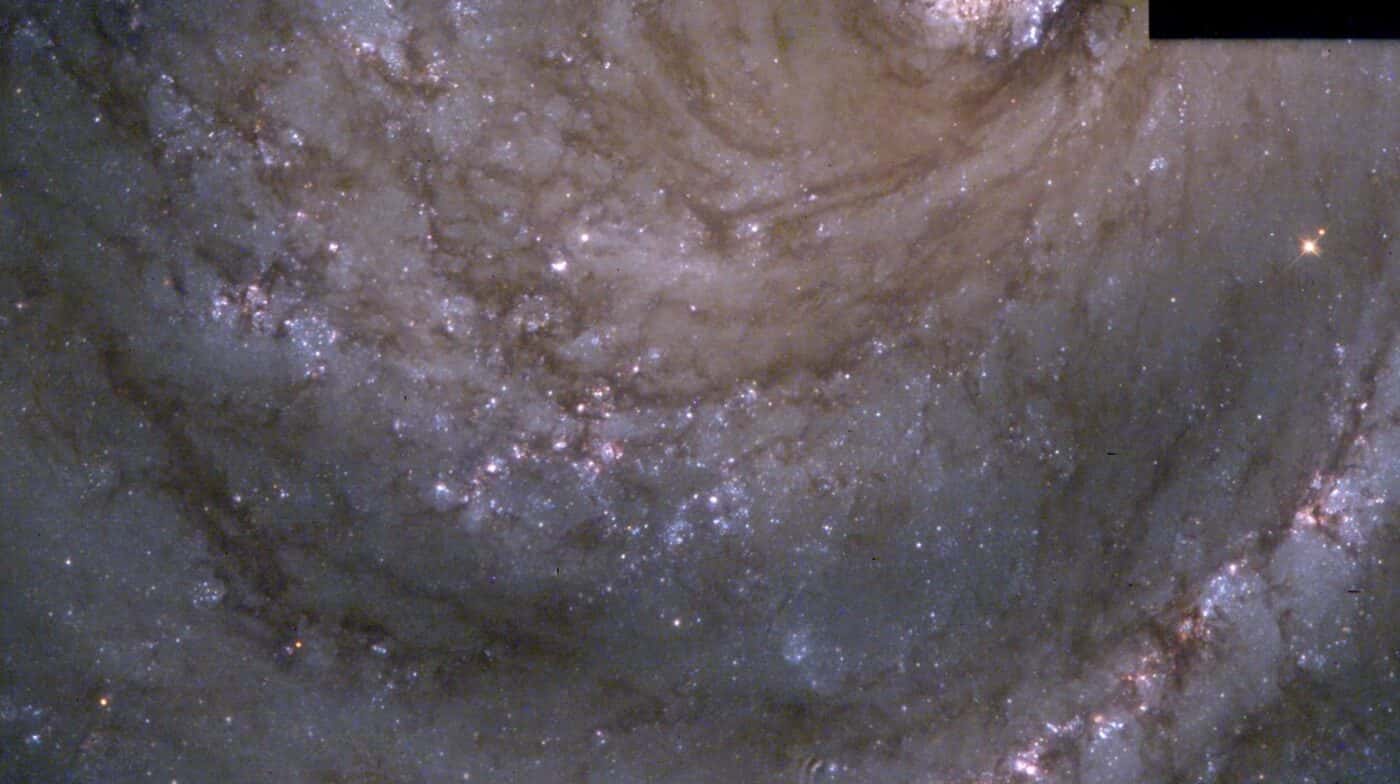
The second builds a ladder out of the nearby universe. Parallax fixes the true brightness of nearby Cepheids, whose pulsation periods give their luminosity through the Leavitt Law; Cepheids in more distant galaxies fix the peak brightness of Type Ia supernovae, bright enough to be followed far past our own neighborhood. Refined over decades by SH0ES with the Hubble Space Telescope, the ladder returns H₀ = 73.04 ± 1.04.
The two chains are exposed differently, and the difference matters more than the gap. The early route carries a single load-bearing assumption, stated in the open, about an epoch from which no light reaches us. The ladder's load-bearing assumption is different in kind: not one model but a sequence of calibrations, each individually inspectable, none inspectable all at once. A fault in the first would be a fact about physics. A fault in the second would be a small systematic hiding in one rung out of several — a search problem, not a discovery. Which side is wrong is a fair question; the two possibilities are not comparable in kind. One would change what we think the universe did. The other would change a number.
Both numbers carry their uncertainties in the open, and they do not overlap: about five standard deviations, odds near one in 1.7 million against a statistical accident, rising as high as 7.1σ when broader modern datasets are combined. Years of audits — Cepheid photometry, supernova calibration, the CMB processing itself — have not turned up a source.
The obvious framing is early against late: either one chain has a bad link, or ΛCDM breaks down between the young universe and the present one. Sorting every available H₀ measurement by method complicates that. Pure ladder results, local measurements with and without ΛCDM, sound-horizon-free methods that never touch the CMB — only the classic Cepheid-supernova ladder clusters near 73; nearly everything else lands closer to 69–71.
That rearranges what an explanation has to accomplish. Early against late asks for new physics somewhere in cosmic history, a large thing to ask for. One ladder against nearly everything else asks something smaller and more awkward: why this particular route to a distance reads high when others do not. That is the question the distribution actually poses.
An independent referee exists in principle. Merging compact objects act as standard sirens, giving a distance that bypasses the sound horizon and the ladder alike. The first, GW170817, returned H₀ = 70 (+12/−8) — consistent with both camps at once. Larger merger catalogs have narrowed toward 69–71, between Planck and SH0ES, but at roughly 11 percent fractional precision cannot rule either side out. Agreement with everyone is not neutrality; it is the absence of information wearing neutrality's clothes.
Theory has offered repairs: early dark energy before recombination, dark matter decaying into radiation, dynamical dark energy, speculative reworkings of spacetime. Each nudges H₀ toward reconciliation and each charges for it — strain on the CMB's polarization data, a worsened anomaly in how matter clusters, or a value still short of the 73 the pure ladder demands. No single model yet satisfies every dataset at once, and the constraint that imposes is tighter than any single number conveys.
So the tension is not, at bottom, a contest between two numbers. It is the place where two chains of inference — each reasonable, each audited by people motivated to break it, each resting on ground it cannot itself inspect — fail to meet. Five standard deviations is what that looks like from outside: the visible seam between two sets of assumptions that were never required to agree, only expected to.
Argued from
Next chapter
A Pattern That May Not Be There