Two independent, rigorous methods for measuring how fast the universe is expanding disagree by about five standard deviations. No known error explains why.
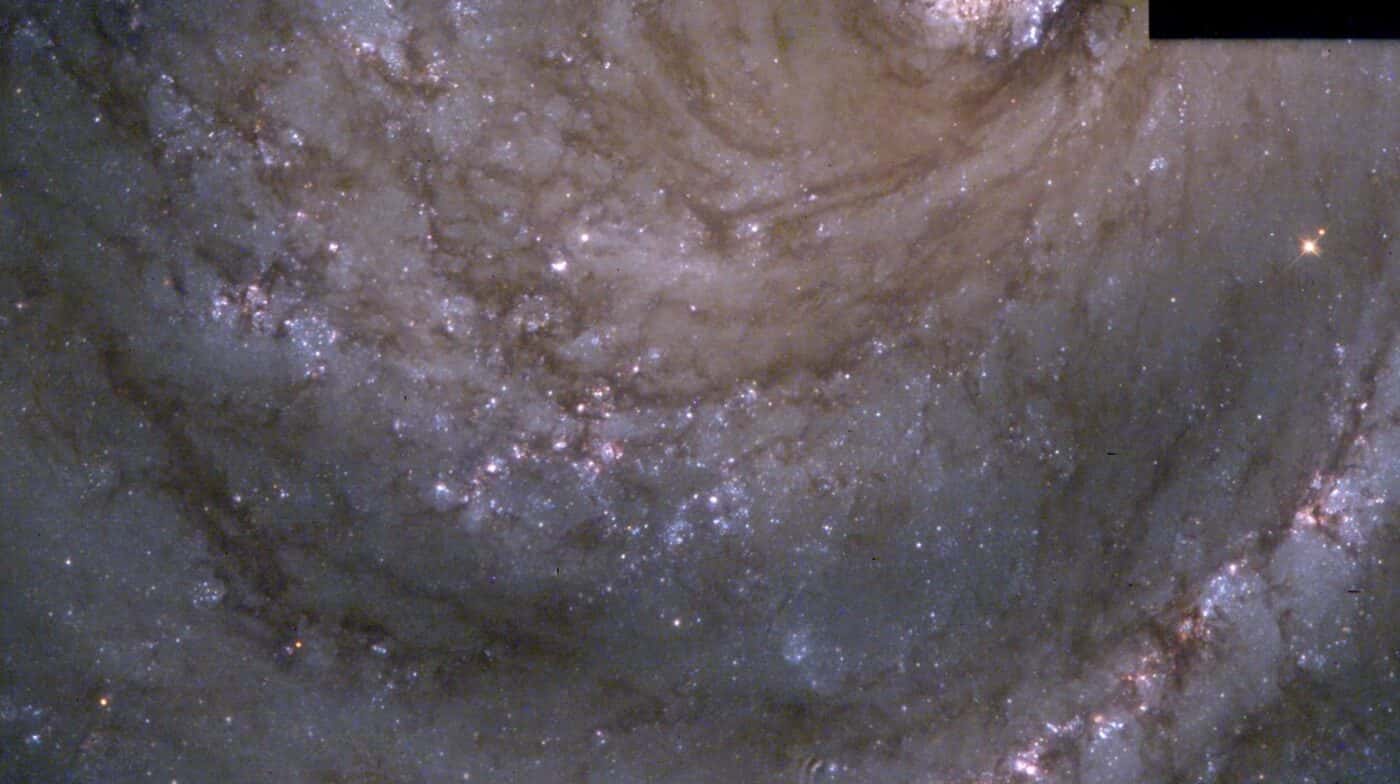
SPIRAL GALAXY M100 · NASA/JPL · J. TRAUGER · PUBLIC DOMAIN
The known landscape
The Hubble constant, H₀, describes how fast the universe is expanding today, measured in kilometers per second per megaparsec. Cosmologists have long measured it by two fundamentally different routes, expecting them to converge as precision improved. Instead, they have pulled apart.
The early-universe route starts with the Cosmic Microwave Background, the relic light released once the cooling universe reached about 3,000 Kelvin and free electrons combined with protons to form neutral hydrogen. Before that moment, radiation and matter were locked together in a dense photon-baryon fluid, and the interplay between gravity and radiation pressure sent acoustic waves rippling through it. When the plasma cooled, those waves froze in place, leaving a standard ruler — the sound horizon, roughly 147 megaparsecs across — imprinted on the CMB's temperature fluctuations. Applying the standard ΛCDM cosmological model to that ruler, the Planck Collaboration's mapping of the CMB yields H₀ = 67.4 ± 0.5 km/s/Mpc, a figure independently echoed by the Atacama Cosmology Telescope, whose own CMB measurements also land near 67.6.
The late-universe route builds a "cosmic distance ladder." Trigonometric parallax calibrates the true brightness of nearby Cepheid variable stars, whose pulsation periods reveal their intrinsic luminosity through the Leavitt Law. Cepheids in distant galaxies then calibrate the peak brightness of Type Ia supernovae, thermonuclear detonations bright enough to track cosmic expansion far beyond our galactic neighborhood. Refined over decades by the SH0ES project using the Hubble Space Telescope, this ladder currently yields H₀ = 73.04 ± 1.04 km/s/Mpc.
The two values disagree by about five standard deviations — a gap so far beyond ordinary measurement error that it represents roughly 99.99994 percent confidence, odds of about one in 1.7 million of being a statistical fluke. Multi-year audits of Cepheid photometry, supernova calibration, and CMB data processing have not found the source. When broader modern datasets are combined, the discrepancy can reach 7.1σ, forcing cosmologists to treat it as a real physical puzzle rather than an artifact awaiting a fix.
The edge
The competing explanations split into two camps: either an undetected systematic error still hides somewhere in one of these mature, independently cross-checked techniques, or the standard ΛCDM model itself breaks down somewhere between the early and late universe.
A broader look at the data complicates even that framing. When every available H₀ measurement is sorted into categories — pure distance-ladder results, local measurements that assume ΛCDM, local measurements that don't, and CMB-independent sound-horizon-free methods — only the classic Cepheid-supernova distance ladder clusters near 73; nearly everything else, including techniques that never touch the CMB at all, lands closer to 69–71. The disagreement is less "early versus late" than a tension between the distance ladder and almost every other method available.
Independent arbiters exist but have not settled the question. Gravitational waves from merging compact objects act as "standard sirens," giving a distance measurement that bypasses both the sound horizon and the distance ladder entirely. The first, GW170817, returned H₀ = 70 (+12/−8) km/s/Mpc — consistent with both rival camps at once. Larger catalogs of black hole mergers have since narrowed the range toward 69–71 km/s/Mpc, sitting almost exactly between Planck and SH0ES, but their uncertainties remain too wide (currently around 11 percent fractional precision) to rule either side out.
Proposed theoretical fixes — early dark energy that briefly sped up the pre-recombination universe, dark matter that decays into radiation, dynamical dark energy, even speculative discrete reworkings of spacetime itself — can each nudge H₀ toward reconciliation, but every one does so at a cost, whether by straining the CMB's polarization data, worsening a separate anomaly in how matter clusters, or simply falling short of the ~73 that pure distance-ladder measurements demand. No single model yet satisfies every dataset simultaneously. The deeper reason the tension resists resolution is that neither headline method is a direct measurement: the early-universe value depends entirely on trusting ΛCDM's description of physics before recombination, which cannot be independently checked without new physics of its own, while the late-universe ladder depends on an unbroken chain of calibration across multiple rungs, any one of which could carry a small, still-unidentified systematic. Until an independent method reaches comparable precision to either headline measurement, the tension has no referee.
From the archive
Our baseline result from the Cepheid-SN sample is H0 = 73.04 ± 1.04 km/s/Mpc, which includes systematics and lies near the median of all analysis variants. [...] We find a 5-sigma difference with H0 predicted by Planck+ΛCDM, with no indication this arises from measurement errors or analysis variations considered to date. The source of this now long-standing discrepancy between direct and cosmological routes to determining the Hubble constant remains unknown.
Adam G. Riess et al., "A Comprehensive Measurement of the Local Value of the Hubble Constant with 1 km/s/Mpc Uncertainty from the Hubble Space Telescope and the SH0ES Team," The Astrophysical Journal Letters 934, L7 (2022). Cataloged at NASA ADS (2022ApJ...934L...7R); preprint arXiv:2112.04510.
Contemplative inquiry
Two of the most carefully audited measurements in modern science, each built by teams determined to eliminate every source of error, still cannot agree on how fast the universe is growing. What does it mean to hold two rigorous, well-evidenced answers to the same question at once, neither one yet disqualified?
The sound horizon and the distance ladder each rest on a chain of earlier discoveries — recombination, the Leavitt Law, standard candles — trusted enough to build the next rung upon. Where else in a life or a body of knowledge might a trusted foundation be quietly carrying more weight than it was ever tested to bear?
Further
- Planck 2018 results VI. Cosmological parameters (source of H₀ = 67.4 ± 0.5) — arXiv
- Riess et al. 2022, A Comprehensive Measurement of the Local Value of H₀ (source of H₀ = 73.04 ± 1.04) — arXiv
- A gravitational-wave standard siren measurement of the Hubble constant (GW170817) — arXiv
- The Hubble tension: A decade review — arXiv
- Dissecting the Hubble tension: Insights from a diverse set of Sound-Horizon-Free H₀ measurements — arXiv
- Early- and Late-Time Modifications to ΛCDM: Implications for the Hubble Tension — arXiv
- Beyond ΛCDM: How the Hubble tension challenges early universe physics — arXiv
- Hubble constant measurement with 13 bright standard sirens from binary black hole mergers inside active galactic nuclei — arXiv