The third gap is an arithmetic problem with a date attached. By the early 2020s astronomers had confirmed quasars powered by black holes of hundreds of millions to billions of solar masses shining when the universe was 400 to 800 million years old. Set that against the clock. The first stars are thought to have ignited around 200 million years after the Big Bang, and if the earliest black holes are what those stars left behind, they began as seeds of perhaps tens to a hundred solar masses. Turning a hundred solar masses into a billion is a factor of ten million, and the time available to do it is a few hundred million years.
There is a ceiling on how fast that can happen. Infalling gas heats and radiates, and the outward push of that radiation eventually offsets gravity's inward pull; the Eddington limit is where the two even out. Crossing seven orders of magnitude on this schedule means feeding at or near that limit almost without interruption — no long pauses, no stretches of running dry. That is the discrepancy: a starting mass, a maximum rate, and a finished object that arrives too early.
The kind of thing missing here is different again. The first chapter wanted a substance and the second a mechanism, both claims about how nature works. The leading accounts of this one ask for no new physics. Gas falls, light pushes back, mass accumulates, and all of that is understood. What is absent is a sequence of events — what happened between a seed and a giant, in particular objects, once. A missing history cannot be derived. It can only be recovered from what survives of it.
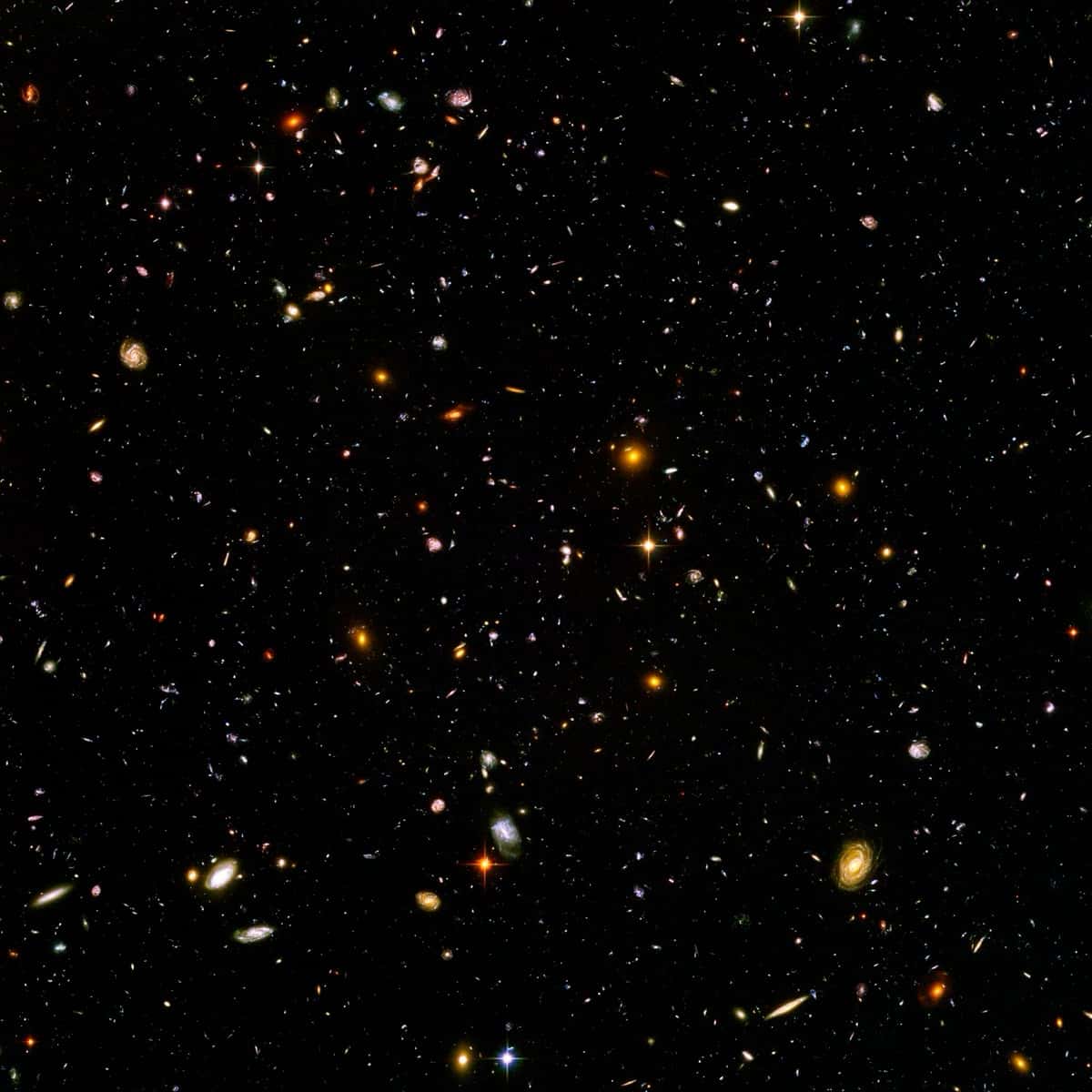
JWST and the Chandra X-ray Observatory, often with a foreground cluster such as Abell 2744 acting as a lens, have turned the arithmetic into a population of real objects. Compact red galaxies nicknamed Little Red Dots host actively feeding black holes that often look too heavy for the galaxies around them — in the nearby universe a central black hole typically runs between about 0.1 and 0.5 percent of the stellar mass around it. One, CANUCS-LRD-z8.6, was already growing a supermassive black hole 570 million years after the Big Bang. Elsewhere a dormant giant of six billion solar masses sits in a galaxy seen when the universe was roughly three billion years old, long since gone quiet.
The candidate histories are separated less by physics than by rarity. A light seed — an ordinary stellar remnant — works if it is born inside an unusually dense star cluster and gorges fast enough to keep pace. A heavy seed skips stars altogether — primordial gas that a neighbor's radiation has kept from cooling collapses whole, arriving at tens of thousands of solar masses without ever making a star. That head start is bought with exacting conditions, which is to say with rarity. A medium path builds intermediate masses through runaway collisions between stars in ultra-dense clusters, at rates far higher than direct collapse allows. Each implies a different number of early giants, so what would decide between them is demographic — how many, how early — and demography needs a population, not a case.
What exists so far is mostly cases, and the strongest of them has been moving the wrong way. UHZ1 was the best evidence for direct collapse: a candidate black hole comparable in mass to its entire host galaxy. A later reanalysis of the full Chandra dataset, including exposure time that had never been published, found the X-ray excess reaching only 2.3 to 2.9 sigma rather than the 4.2 to 4.4 originally reported. MIRI on JWST — thousands of times more sensitive than its predecessors — saw nothing at that position.
One detail in that reanalysis is worth more than the sigma values. The significance did not grow steadily as exposure time was added, the way a persistent real source's would. That is a test of a different kind from counting standard deviations: not how unlikely the signal is by chance, but whether it behaves like a thing. A source that is there gets more certain the longer it is watched. A fluctuation does not.
Underneath sits a limit that care cannot remove. These detections often rest on something like twenty photons against a background of about twenty, and every mass estimate built on counts that sparse carries uncertainty that compounds at every step. It is the thinnest evidence in this journey by a wide margin, and it is being asked to distinguish between histories whose seeds differ by orders of magnitude in mass.
Which makes this the gap most likely to be misread while it stays open, and also the one that could close without anybody learning something new about nature. What is needed is a record — larger surveys of early quasars and Little Red Dots, statistically robust where the present detections sit at threshold. Until those arrive, the accurate description of what we have is not a mystery about black holes. It is a small number of photons, and rather more inference than they can carry.
Argued from
Next chapter
Made of the Remainder